Translate this blog in your favourable language

My pager view

Monday, March 26, 2012

history of fc barcelona

Itroduction

  HISTORY OF FC BARCELONA

On November 29, 1899, Hans Gamper founded Futbol Club Barcelona, along with eleven other enthusiasts of 'foot-ball', a game that was still largely unknown in this part of the world.
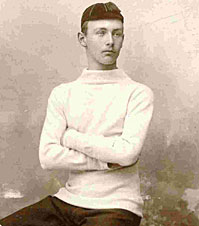
Image associated to news article on:  HISTORY OF FC BARCELONA  He could never have imagined the magnitude of what that initiative would eventually develop into. Over more than one hundred years of history, FC Barcelona has grown spectacularly in every area and has progressed into something much greater than a mere sports club, turning Barça’s ‘more than a club’ slogan into a reality.

Barça has become, for millions of people all around the world, a symbol of their identity, and not just in a sporting sense, but also in terms of society, politics and culture. Throughout the most difficult of times, Barça was the standard that represented Catalonia and the Catalan people's desire for freedom, a symbolism that has continued to be closely linked to the idiosyncrasy of the Club and its members to this day. Within the context of Spain, Barça is seen as an open and democratic club. And all around the world, Barça is identified with caring causes, and most especially children through its sponsorship agreement with Unicef.

For a whole century, FC Barcelona has passed through moments of glory and pain, periods of brilliance and other less successful ones, epic victories and humbling defeats. But all these different moments have helped define the personality of a Club that, due to its peculiar nature, is considered unique in the world.

With over one hundred years of history, there have naturally been many different periods, both in a social and a sporting sense. In the early years (1899-1922) , from the foundation of the club to the construction of Les Corts stadium, Barça was a club that had to distinguish itself from all the other football teams in Barcelona, to the point that it would come to be identified with the city as a whole. Barça soon became the leading club in Catalonia, and also associated itself with the increasingly growing sense of Catalan national identity.
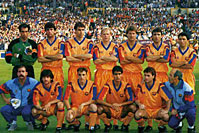
Image associated to news article on:  HISTORY OF FC BARCELONA

From Les Corts to the Camp Nou (1922-1957), the club went through contrasting periods. Its membership reached 10,000 for the first time, while football developed into a mass phenomenon and turned professional, and these were the years of such legendary figures as Alcántara and Samitier. But due to material difficulties and the political troubles of the Spanish Civil War and post-war period, the club was forced to overcome several adverse circumstances, including the assassination of president Josep Sunyol in 1936, the very person who had propagated the slogan ‘sport and citizenship'. But the club survived, and a period of social and sporting recovery materialised in the form of the Camp Nou, coinciding with the arrival of the hugely influential Ladislau Kubala.

From the construction of the Camp Nou to the 75th anniversary (1957-1974) , Barça suffered mediocre results but was consolidated as an entity, with a constantly increasing membership and the slow but steady recovery, in the face of adversity, of its identity. A very clear sensation that was manifested for the first time ever in the words ‘Barça, more than a club’ proclaimed by president Narcís de Carreras. The board presided by Agustí Montal brought a player to Barcelona who would change the history of the club, Johan Cruyff.
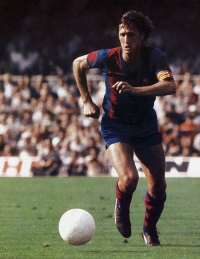
Image associated to news article on:  HISTORY OF FC BARCELONA

From the 7th anniversary to the European Cup (1974-1992) the club saw the conversion of football clubs to democracy, the start of Josep Lluís Núñez’s long presidency, the extension of the Camp Nou on occasion of the 1982 World Cup and the Cup Winners Cup triumph in Basle (1979), a major success not just in a sporting sense but also in a social one, with an enormous and exemplary expedition of Barça supporters demonstrating to Europe the unity of the Barcelona and Catalan flags. Cruyff returned, this time as coach, and created what would come to be known as the 'Dream Team' (1990-1994), whose crowning glory was the conquest of the European Cup at Wembley (1992), thanks to Koeman’s famous goal.
 International Dominance. From Wembley to Abu Dhabi (1992-2009) was when the club’s most recent developments occurred in between its three greatest achievements, becoming champions of Europe. Josep Lluís Núñez’s long presidency came to an end, and the club displayed its finest potential during the celebrations of the club Centenary. Following on from Joan Gaspart (2000-2003), the June 2003 election brought Joan Laporta into office, and the start of new social expansion, reaching 172,938 members, and more successes on the pitch, including four league titles, the Champions League titles won in Paris and Rome and the FIFA Club World Cup.

Saturday, March 17, 2012

DO YOU KNOW THE HISTORY OF ELECTRICITY? Learn more here.


Who discovered electricity and when?

Electricity was not 'invented' : its characteristics and uses have been known about and developed over hundreds of years. Static electricity produced by rubbing objects against fur was known to the ancient Greeks, Phoenicians, Parthians and Mesopotamians. Greek philosophers discovered that when amber is rubbed against cloth, lightweight objects will stick to it. This is the basis of static electricity. When you touch something and get a shock, that is really static electricity moving through you.


Despite what you may have learned, Benjamin Franklin did not "invent" electricity. In fact, electricity did not begin when Benjamin Franklin flew his kite during a thunderstorm or when light bulbs were installed in houses all around the world.

The truth is that electricity has always been around because it naturally exists in the world. Lightning, for instance, is simply a flow of electrons between the ground and the clouds. Hence, electrical equipment like motors, light bulbs, and batteries aren't needed for electricity to exist. They are just creative inventions designed to harness and use electricity.


Over the centuries, there have been many discoveries made about electricity. We've all heard of famous people like Benjamin Franklin and Thomas Edison, but there have been many other inventors throughout history that were each a part in the development of electricity.


Electricity was discovered long before 1831. Chemical batteries have been around since ancient Greece. One of the earliest scientists to begin to quantify electric charges was the French physicist Charles-Augustin Coulomb (1736-1806). His law for measuring the magnitude of electric charge is still a cornerstone in modern physics. Ampere and Ohm defined current and resistance in direct current and Nikola Tesla invented the AC generator in the late 19th century.


Electricity wasn't invented : its properties were discovered, examined and explained.
  • Thales of Miletus in ancient Greece is one of the the earliest writers on experimentation with electrical properties. In 600 AD he wrote of static electricity that attracted pieces of straw and hair to rubbed rods of amber. (see related question below)
  • Benjamin Franklin proved that lightning was electrical in nature. He performed several experiments with the properties of the (known) force of electricity. While people have known about the powerful effects of lightning for thousands of years, the first person to discover that lightning was a naturally occurring form of electricity was Benjamin Franklin. In 1752, during a dangerous electrical storm, Franklin flew a kite that had a metal key at the bottom of the string. When a bolt of lightning hit the kite, a spark of electricity flew from the key! From this experiment, Franklin invented the lightning rod, which attracts lightning and draws it into the ground. This saves many buildings from burning down.
  • The first true electric battery was built in 1779. Alessandro Volta invented the first source of continuous electric current in his experiments with non-static electricity. He created a battery out of stacks of zinc and copper, with weak acids in between each layer.
                                 what is electricity
Electricity is a form of energy involving the flow of electrons. All matter is made up of atoms, and an atom has a center, called a nucleus. The nucleus contains positively charged particles called protons and uncharged particles called neutrons. The nucleus of an atom is surrounded by negatively charged particles called electrons. The negative charge of an electron is equal to the positive charge of a proton, and the number of electrons in an atom is usually equal to the number of protons. When the balancing force between protons and electrons is upset by an outside force, an atom may gain or lose an electron. When electrons are "lost" from an atom, the free movement of these electrons constitutes an electric current.
Electricity is a basic part of nature and it is one of our most widely used forms of energy. We get electricity, which is a secondary energy source, from the conversion of other sources of energy, like coal, natural gas, oil, nuclear power and other natural sources, which are called primary sources. Many cities and towns were built alongside waterfalls (a primary source of mechanical energy) that turned water wheels to perform work. Before electricity generation began slightly over 100 years ago, houses were lit with kerosene lamps, food was cooled in iceboxes, and rooms were warmed by wood-burning or coal-burning stoves. Beginning with Benjamin Franklin's experiment with a kite one stormy night in Philadelphia, the principles of electricity gradually became understood. In the mid-1800s, everyone's life changed with the invention of the electric light bulb. Prior to 1879, electricity had been used in arc lights for outdoor lighting. The lightbulb's invention used electricity to bring indoor lighting to our homes.

MIILI YA WAPENZI WALIOFUMANIWA YAKATAA KUTENGANA NCHINI KENYA!

MIILI YA WAPENZI WALIOFUMANIWA YAKATAA KUTENGANA NCHINI KENYA!

BASATA YATOA KAULI KUHUSU STORI KWAMBA MAREHEMU JAMES DANDU NDIO MUANZILISHI WA TUZO ZA MUZIKI TANZANIA.

BASATA YATOA KAULI KUHUSU STORI KWAMBA MAREHEMU JAMES DANDU NDIO MUANZILISHI WA TUZO ZA MUZIKI TANZANIA.

Tuesday, March 13, 2012

The Importance of Market Research to mantain your business..


Is of great importance to study the markets when you want to do business there one has told me he began to do and the answer may be here that there is a requirement of the most important should be recognition before setting up any business because they must also know the market and the needs of this market and then you see if it pays, then you can open a business, as you used to do business of fighting rush off do not expect huge success and you can not stand firm in any business. The following are different ways to market your business to be there with a good productivity commercial ... accompany me to briefly
  • Businesses that invest time in market research increase their chances of succeeding in international markets.
  • Researching potential markets can help your company by:
    • Finding where your products are most likely to sell
    • Identifying market segments and niches
    • Determining both domestic and international competitors
    • Your company may begin exporting without any market research if it receives unsolicited orders from abroad.
      • But, you will find even more promising markets by conducting a systematic search.
    • Discovering how to overcome barriers to market entry
    • Understanding customers' needs
    • Identifying new trends
    • Establishing fair market prices for your products 


    • Primary Market Research is when a company collects data directly from the foreign marketplace by
      • Conducting interviews
        • In person
        • Over the telephone
      • Employing surveys
      • Using focus groups
      • Conducting field tests
      • Contacting
        • Potential representatives
        • Potential buyers and resellers
        • End users 

         Secondary Market Research is when a company collects data indirectly from various sources.
        • Government agencies and trade associations
          • Economic and trade statistics
          • Demographic data
        • News Media
          • International news reports